Graduate studies have been more than an academic journey for me. It has been a process of learning how to claim space, lead with intention, and redefine what leadership looks like as an Asian woman. Entering graduate school, I carried with me not only academic goals, but also cultural expectations, gendered assumptions, and a quiet pressure to succeed without being “too visible.”
Like many Asian women of Uzbek background, I was taught, explicitly or implicitly, that good students are diligent, respectful, and unobtrusive. While these values shaped my strong work ethic, they also made leadership feel distant, as if authority and voice belonged to others. Graduate school challenged that belief and helped me reaffirm that leadership does not have to be loud to be powerful, nor dominant to be effective.
As a student in the faculty of Education, I learned as much from how faculty taught as from what they taught. Their commitment to respectful, relational pedagogy demonstrated the kind of leadership and educational practice I aspire to carry forward.
Throughout my program, I have been involved in several community-based and feminist-centered projects that reflect the Faculty of Education’s commitment to equity, inclusion, and collective learning. These experiences reinforced for me that education is not only about knowledge production, but also about creating spaces where people feel supported, heard, and empowered to contribute meaningfully.
One of the most transformative leadership experiences of my graduate journey emerged through the Racialized Graduate Students Community (RGSC), a space led by Abu Arif that centers the experiences of racialized graduate students. RGSC was not only a support network; it was a space of possibility. Within this community, another graduate student, Bahareh, and I co-created and facilitated SheWrites Circle, a weekly gathering for graduate students who self-identify as women.
At the outset, I was uncertain about what SheWrites Circle should look like. When I was told that it could be “anything that you envision,” I felt both surprised and unsettled. Being entrusted with that level of autonomy was unfamiliar to me. Yet, that trust became a turning point. It invited me to imagine a space rooted in feminist principles. What began as an uncertain idea grew into a vibrant and well-attended community, affirming the need for such spaces within graduate education.
Through SheWrites Circle, I learned that leadership does not require having all the answers. Instead, it requires the courage to begin, the willingness to listen, and a commitment to nurturing community. This experience reshaped my understanding of feminist leadership as something lived and practiced, through shared power, mutual trust, and collective care.
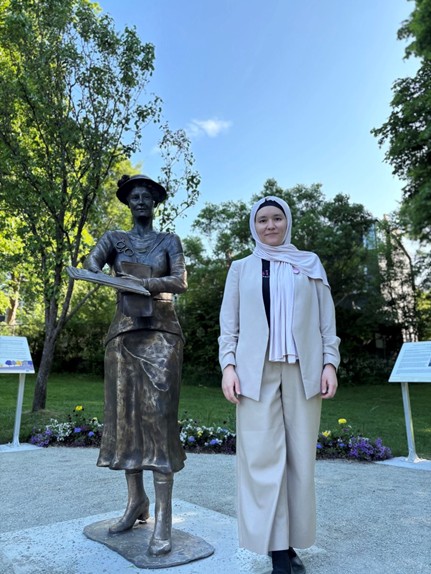
Beyond initiatives within my faculty, I also contributed to feminist projects that connect education, history, and public memory. One such initiative was dedicated to commemorating the life and legacy of Armine Nutting Gosling, a pioneering suffragist and social reformer in Newfoundland and Labrador. Central to this project was the creation of a life-sized bronze statue by local artist Sheila Coultas, installed in Bannerman Park, St. John’s—the first statue in the city to honour a named woman and the first in the province designed by a female sculptor. The project extended beyond the statue to include educational outreach, inviting reflection on women’s historical contributions. As part of this work, I shared my own lived experiences (read more here).
My leadership development has also extended into formal academic spaces. As a graduate student representative on the Review Committee for the Graduate Diploma and M.Ed. programs in Inclusive and Special Education, I contributed to program review and decision-making processes. This role allowed me to engage with institutional leadership and advocate for student perspectives.
Reflecting on my graduate journey, I can say that graduate studies provided me with the language, tools, and confidence to lead authentically by building community, centering marginalized voices, and embracing care as a strength. As an Asian woman, this journey has been about moving from hesitation to trust, from silence to voice, and from individual achievement to collective impact. Graduate studies in Education gave me the confidence to engage critically with systems of power and contribute meaningfully within and beyond academia. Most importantly, it taught me that my voice belongs in these spaces.
It also taught me that when students are trusted and supported, they do more than participate; they imagine, lead, and create spaces where others can thrive. I carry these lessons forward with gratitude for the communities that made this growth possible and with a commitment to fostering inclusive, feminist leadership in education wherever I go next.
To other Asian women and marginalized students considering graduate studies: your presence is not an exception; it is a contribution. Leadership can look like you. Feminism can sound like your story. And graduate school can be a place not only where you earn a degree, but also where you discover your capacity to lead with purpose and conviction.
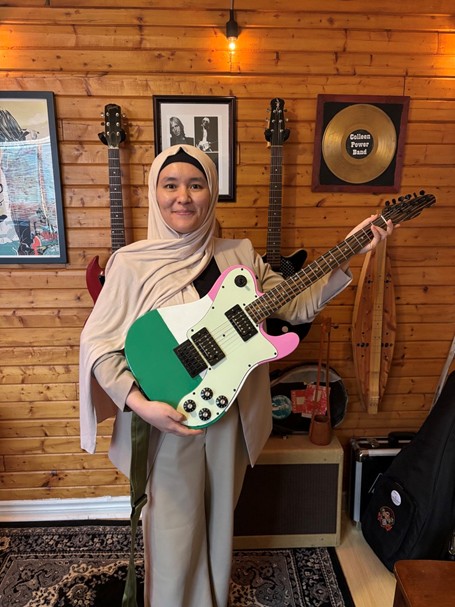
Photo description: Like a guitar needs tuning, my voice needed space, mentorship, and belonging. I am grateful to Newfoundland and Labrador and to MUN for giving me all three.
Want to continue the conversation? You can find me on LinkedIn.